

Department Faculty Members and Student Researcher Receive ACNP Travel Awards
The American College of Neuropsychopharmacology (ACNP) selected three faculty members (Drs. Jay Fournier, Danella Hafeman and Judith Morgan) and a Medical Scientist Training Program (MSTP) student (Dr. Wonjae Chung) in the Department of Psychiatry to receive travel awards. ACNP annually selects distinguished young scientists in the field of neuropsychopharmacology to receive these awards, which offer an opportunity to attend the organization’s annual meeting. This outstanding scientific program in clinical and basic research on brain-behavior-drug interactions allows them to learn about recent advances in the field and to meet and interact with internationally distinguished scientists.
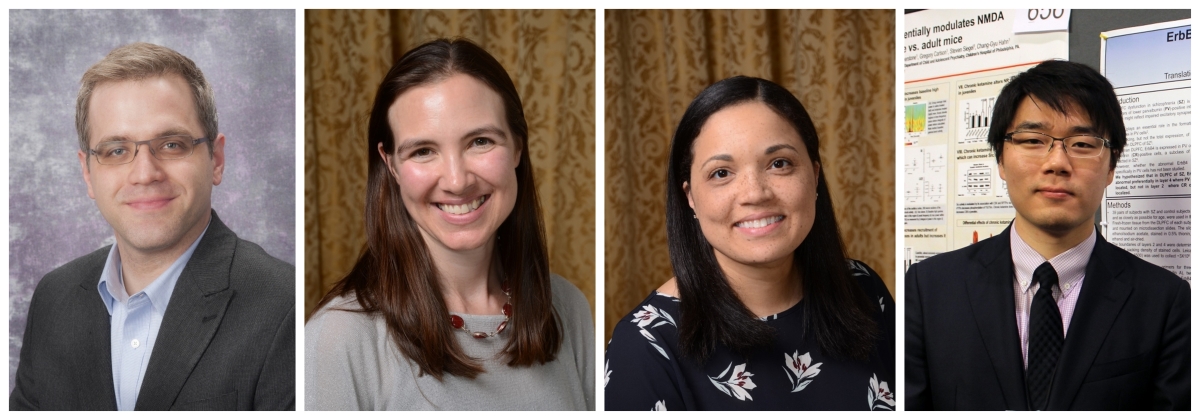
Jay Fournier, PhD, Assistant Professor of Psychiatry, focuses on identifying patient characteristics associated with differential response to various treatments for depression, including placebo, antidepressant medications, and psychotherapy. In addition, his work investigates the mechanisms through which those characteristics either facilitate or inhibit response to relevant treatments. His research bridges work in clinical interventions, personality, and affective neuroscience. Dr. Fournier’s study “Neural Markers of Individual Difference in Emotion Regulation in Depressed Adults” is supported by an NIMH K23 Career Development Award.
Danella Hafeman, MD, PhD, Assistant Professor of Psychiatry, focuses on youth with and at risk for bipolar disorder. She is interested in understanding clinical and neural mechanisms of risk and resilience in these youth, with the goal of preventing mood disorders in this vulnerable population. She works as a child psychiatrist in the Child and Adolescent Bipolar Services clinic, where she evaluates and treats youth with and at risk for bipolar disorder. Dr. Hafeman’s study “Compensatory Neural Networks for Emotion Regulation in Youth at Risk for Bipolar Disorder” is supported by an NIMH K23 Career Development Award.
Judith K. Morgan, PhD, Assistant Professor of Psychiatry and Psychology, focuses on the neural response to reward in young children and the early experiences that can shape these processes to inform the development of preventive interventions for children at risk for depression. Her work examines how early experiences shape child neural and social development and how these early processes are related to the onset of clinical disorders during adolescence. Dr. Morgan’s work currently is supported by an NIMH K01 Career Development Award, a NARSAD Young Investigator Award, and an NIMH Biobehavioral Research Award for Innovative New Scientists (BRAINS) grant.
Wonjae Chung, PhD, currently a fourth-year medical student, completed his PhD in the MSTP under the mentorship of Dr. David Lewis. His interests encompass translating basic science findings into novel therapeutic strategies for patients with neuropsychiatric disorders, specifically the neurobiology of schizophrenia. Dr. Chung’s work demonstrated that excitatory synapse density is lower selectively on parvalbumin interneurons in schizophrenia and predicts the activity-dependent downregulation of gene expression in these neurons. This finding reveals a novel pathological substrate for cortical dysfunction and cognitive deficits in schizophrenia.
Sidebar
Department Faculty Members Elected to ACNP Membership
Department of Psychiatry faculty members Howard Aizenstein, MD, PhD and Susanne Ahmari, MD, PhD, were elected as members and Mary Torregrossa, PhD, was elected as an associate member of the American College of Neuropsychopharmacology (ACNP) at its annual meeting December 3-7, 2017 in Palm Springs, CA.
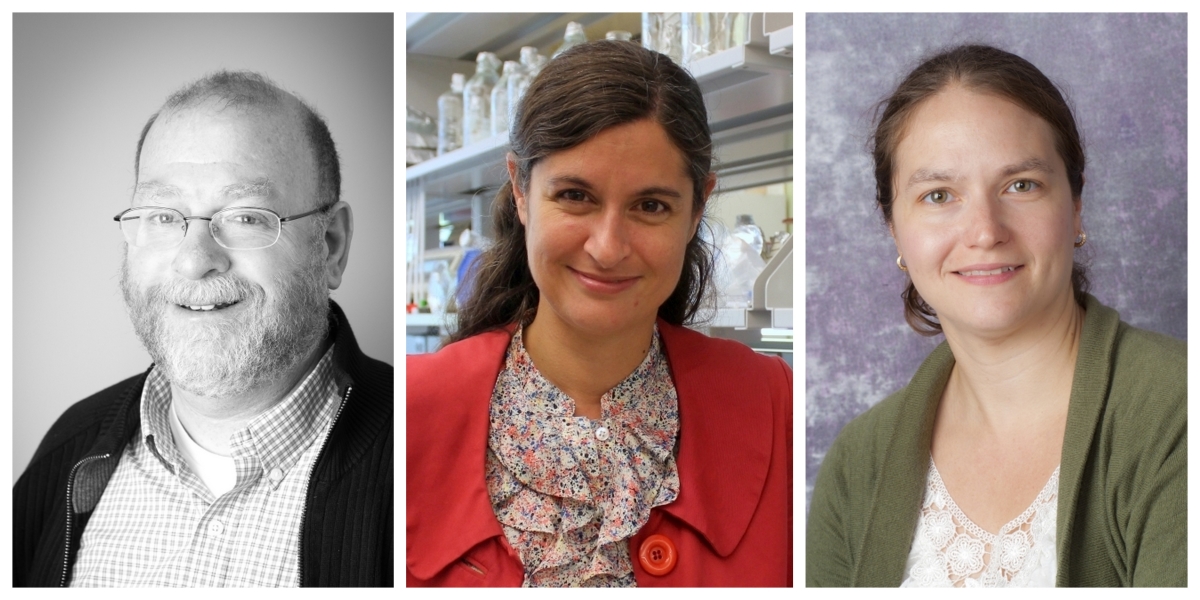
An expert in geriatric psychiatry, Dr. Aizenstein is the Charles F. Reynolds III and Ellen G. Detlefsen Endowed Chair in Geriatric Psychiatry and Professor of Bioengineering and Clinical and Translational Science. He directs the Geriatric Psychiatry Neuroimaging Laboratory and co-directs the Psychiatry Neuroimaging Program at the University of Pittsburgh. He also is co-director of the Clinical Research Training in Late-Life Mood Disorders T32 Postdoctoral Training Program. Dr. Aizenstein is well-known for his research focusing on the cognitive and affective neuroscience of aging.
Dr. Ahmari, Assistant Professor of Psychiatry, is an expert on the mechanisms of obsessive compulsive disorder. She is a pioneer in the use of optogenetics to uncover mechanisms of psychiatric disease. In addition to conducting innovative basic science research, the Ahmari Laboratory serves as an important training ground for students and postdoctoral scholars interested in pursuing careers in psychiatric research.
The research activities of Dr. Torregrossa, Assistant Professor of Psychiatry, focus on the neurological basis of addictive disorders from the perspective of identifying risk factors to develop effective treatment strategies. She is particularly interested in how motivational, cognitive, and learning and memory systems are altered in the brain and uses animal models of addictive disorders to identify novel means of prevention and treatment.
Congratulations to these faculty members on this notable accomplishment!